
With over 600 muscles in the human body, the triceps stand out as a key player in daily life. Every time you straighten your arm—whether while dancing, bouncing a ball, vacuuming, or washing windows—you rely on this muscle. Strengthening your triceps can enhance your quality of life and contribute to more defined arms. To build this muscle effectively, you need to move it against resistance, and dumbbells offer a simple, affordable way to do just that. By learning proper techniques, you can easily boost your arm strength.
What exactly are the triceps? While “tri-” suggests three separate muscles, the triceps is actually a single muscle located on the back of the upper arm. Its name refers to its three heads or points of attachment. The lateral head attaches to the back of the humerus near the shoulder on the outer side of the arm. The medial head also connects to the humerus, positioned about halfway down the arm. The long head attaches to the shoulder blade, supporting movements of the shoulder and upper arm. Together with the biceps, the triceps forms a partnership: when one contracts, the other relaxes. These muscles are involved in nearly every arm movement. You can strengthen them through exercises that target both, like push-ups, or by isolating each with specific workouts.
When planning triceps workouts with dumbbells, consider these exercises. Triceps kickbacks are accessible to almost anyone, with options to adjust your stance for balance issues. Triceps extensions require raising a dumbbell overhead, making them slightly more demanding. The lying overhead extension is ideal for those with balance problems or dizziness when standing. The narrow press, a variation of the chest press, is performed while lying on your back. For a more challenging option, the T plank with torso rotation involves holding and moving a dumbbell in a side plank position.
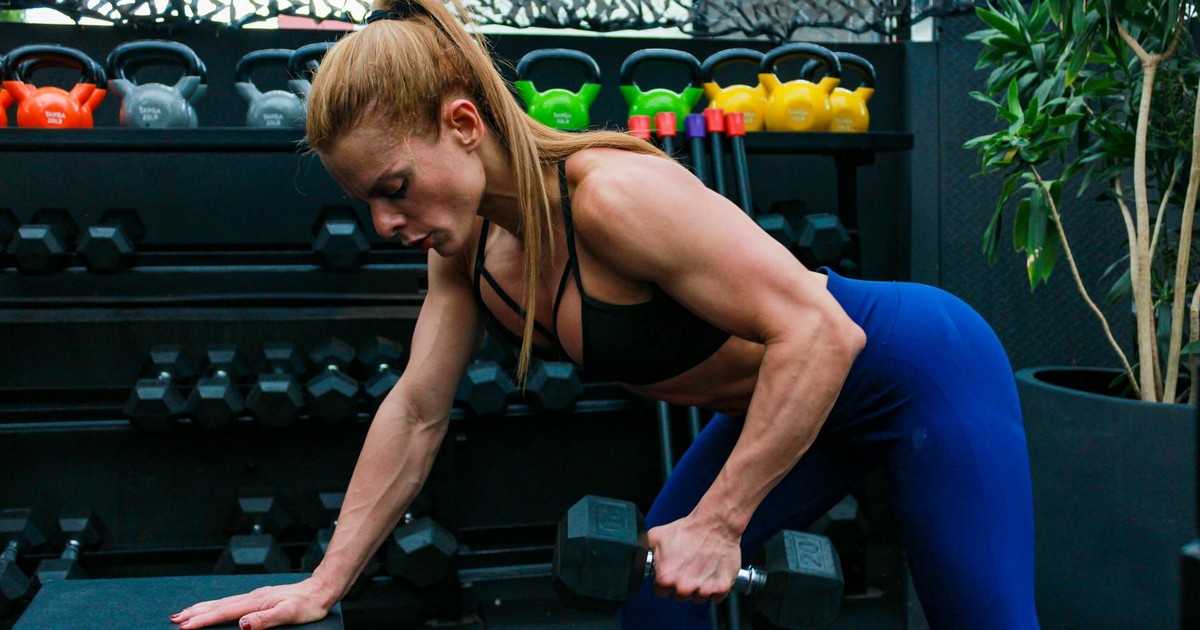
To perform these exercises correctly, follow these steps. For triceps kickbacks, hold a dumbbell in each hand, hinge at the hips while keeping your spine straight, bend elbows to 90 degrees, then slowly straighten arms while squeezing shoulder blades together before returning to start. For triceps extensions, use both hands to hold one dumbbell in a split stance, raise it overhead, bend elbows to lower it behind your head to a 90-degree angle, then straighten arms upward. For lying overhead extensions, lie on your back with knees bent, hold dumbbells toward the ceiling, lower them toward your ears, then raise them back up. For the narrow press, lie on your back with dumbbells in hand, palms facing each other, raise them toward the ceiling, lower with elbows close to sides, and repeat. For the T plank with torso rotation, assume a side plank on your left side, hold a dumbbell in your right hand, rotate torso to move it below your body, then straighten to point the arm upward.
Exercise benefits everyone, even those limited by injury, disability, or illness. Modifications can tailor strength training to your needs. Adapt triceps kickbacks by doing one side at a time in a split stance, resting a hand on the forward leg for support, or using a bench for stability by placing one knee and hand on it while working the opposite arm. Perform triceps extensions seated or lying on a bench. Try the lying overhead extension one side at a time to engage the core. Do the narrow press on a bench, which is less stable than the floor and activates more muscles.
Avoid common mistakes when using dumbbells. Always warm up first with cardio or dynamic stretches to prevent cold muscles. Don’t go too light on weight—choose a challenge for your muscles. Maintain proper form; if you can’t, reduce weight or reps. Lift slowly to avoid using momentum through swinging or jerking. Never ignore pain beyond a gentle burn; stop the exercise if it occurs.
Strength training with dumbbells, like triceps exercises, improves muscles at a cellular level, making individual cells stronger. This practice boosts overall health: cardiovascular function enhances, digestion improves, mental health benefits, and bones become stronger. For older adults, it can help maintain independence longer.